
Today, customers often search online before choosing a business. Whether they are looking for a product, service, restaurant, local company, or professional, a strong online presence can influence their decision.
For small businesses, having an online presence is no longer just an advantage. It has become an important part of building credibility, reaching new customers, and growing a business.
The good news is that building a strong online presence does not require a huge budget. With the right strategy and consistent effort, small businesses can create a professional digital presence.
1. Create a Professional Website
Your website is often the central point of your online presence.
A good business website should clearly explain who you are, what you offer, and how customers can contact you.
Make sure your website is:
- Easy to navigate
- Mobile-friendly
- Fast to load
- Easy to understand
- Professionally designed
- Clear about your products or services
- Equipped with simple contact options
Your website should make it easy for visitors to take the next step, whether that means making a purchase, sending an enquiry, booking an appointment, or contacting your business.
2. Build a Strong Google Presence
For local businesses, being visible when people search online is extremely important.
Keep your business information accurate and updated across relevant Google business listings and other online platforms.
Your business name, location, phone number, website, opening hours, photographs, and services should be clear and consistent.
Positive and genuine customer reviews can also help build trust with potential customers.
3. Be Active on Social Media
Social media allows customers to see the personality behind your business.
Choose platforms that your target audience actually uses instead of trying to be active everywhere.
Share useful content, product information, customer stories, videos, updates, and behind-the-scenes content.
Most importantly, communicate with your audience rather than simply posting advertisements.
4. Create Useful Content
Content marketing can help businesses attract people who are searching for information.
For example, a business can publish:
- Blog articles
- How-to guides
- FAQs
- Tips and tutorials
- Videos
- Customer stories
- Industry insights
Useful content can demonstrate your knowledge and help customers understand why they should choose your business.
5. Focus on SEO
Search engine optimization helps potential customers discover your website through search engines.
Small businesses should focus on creating helpful content around the questions and topics their customers are actually searching for.
Use clear page titles, useful headings, relevant keywords, descriptive content, and good website structure.
SEO is a long-term strategy, so businesses should focus on consistent improvement rather than expecting immediate results.
6. Build Trust Through Reviews
Before buying a product or choosing a service, many customers look at reviews.
Encourage satisfied customers to leave genuine reviews and respond professionally to both positive and negative feedback.
Reviews can provide social proof and help potential customers feel more confident about choosing your business.
7. Keep Your Brand Consistent
Your business should look and feel consistent across different online platforms.
Use consistent branding, messaging, images, logos, and contact information on your website and social media profiles.
A consistent brand makes it easier for customers to recognize and remember your business.
8. Make Communication Easy
Customers should never have to search for a way to contact your business.
Provide clear contact options such as phone, email, messaging, enquiry forms, or other appropriate communication channels.
Responding quickly and professionally can make a major difference in customer experience.
9. Track Your Online Performance
Building an online presence is only the beginning. Businesses should also measure what is working.
Monitor website traffic, search visibility, social media engagement, enquiries, leads, and conversions.
These insights can help you understand where your customers are coming from and which marketing activities are producing results.
10. Keep Improving
Digital marketing is constantly changing. New platforms, technologies, search behaviors, and customer expectations continue to develop.
A strong online presence therefore requires ongoing improvement.
Update your website, create fresh content, respond to customers, improve your SEO, and experiment with new marketing strategies.
Small improvements made consistently can create significant results over time.
Final Thoughts
A strong online presence is built through more than just having a website or social media account.
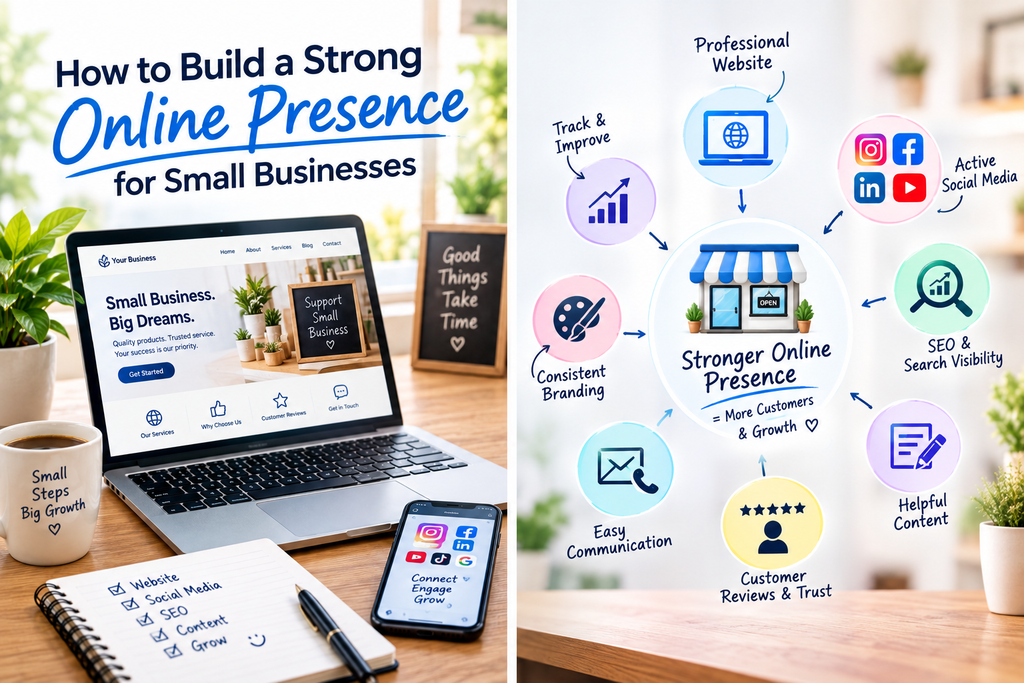
It requires a combination of a professional website, search visibility, useful content, social media activity, positive customer experiences, consistent branding, and regular communication.
For small businesses, the goal should not simply be to be visible online. The goal is to be visible, trustworthy, useful, and easy to connect with.
By building a strong digital presence and consistently improving it, small businesses can reach more customers, build long-term trust, and create sustainable growth.